Who we are

Owkin is an AI biotechnology company startup that uses AI to find the right treatment for every patient. We combine the best of human and artificial intelligence to answer the research questions shared by biopharma and academic researchers. By closing the translational gap between complex biology and new treatments, we bring new diagnostics and drugs to patients sooner.
We use AI to identify new treatments, de-risk and accelerate clinical trials and build diagnostic tools. Using federated learning, a pioneering collaborative AI framework, Owkin enables partners to unlock valuable insights from siloed datasets while protecting patient privacy and securing proprietary data.
Owkin was co-founded by Thomas Clozel MD, a former assistant professor in clinical onco-hematology, and Gilles Wainrib, a pioneer in the field of machine learning in biology, in 2016. Owkin has raised over $300 million and became a ‘unicorn’ through investments from leading biopharma companies (Sanofi and BMS) and venture funds (Fidelity, GV and BPI, among others).
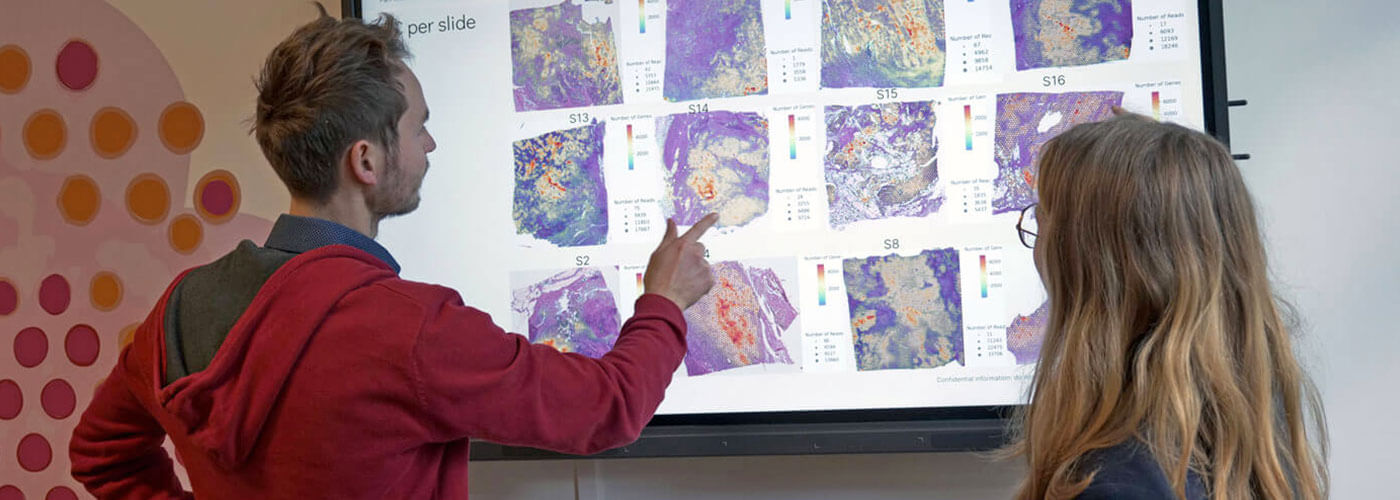
Owkin is well placed to drive the MOSAIC initiative, because the multimodal approach involved is in perfect synergy with Owkin’s key strengths in developing and applying AI and deep learning to the integration and analysis of tissue images, spatial omics and other multiomics data.
Vassili Soumelis, Chief Medical Officer, Owkin
Eric Durand, Chief Data Science Officer, Owkin
Hubert Chaperon, Chief Growth Officer, Owkin
OPTIMA - New research project aims to improve treatment for patients with prostate, breast and lung cancer through AI. Read more
Big Picture - A new consortium of the EU Innovative Medicines Initiative (IMI) will establish the biggest database of pathology images. Read more
PortrAIt - A consortium to accelerate precision medicine through AI-enabled digital pathology. Read more

Research results from Erlangen are setting new standards for prevention, diagnostics and therapy. With 43 departments and eight institutes that comprehend every field of modern medicine, every patient at Erlangen benefits from the latest available treatment methods.
Thanks to initiatives such as the Comprehensive Cancer Center WERA and Bavarian Cancer Research Center (BZKF; governed by Erlangen), Erlangen is considered among few centers of excellence for oncology research and treatment, fostering interdisciplinary approaches between medical care, research, and teaching. Recently Erlangen as part of CCC WERA alliance has also been appointed as part of the National Center for Tumor Diseases (NCT WERA) by the German state government, and will be a future driver of excellence in oncology and cancer research.
Erlangen is a major contributor to the MOSAIC project. Their deep expertise in cancer research – especially in tumor immunology- using both clinical data and biomaterials is a core asset for MOSAIC, enhancing disease courses analysis, fostering improved treatments development, and enabling new investigational methods at the highest scientific standards.
Arndt Hartmann - Director of the Institute of Pathology
Markus Eckstein - Medical Doctor at the Erlangen Pathology Institute
Ramona Erber- Medical Doctor at the Erlangen Pathology Institute
TRR 305 - Striking a moving target: From mechanisms of metastatic organ colonisation to novel systemic therapies. Read more
NCT WERA: A long-term cooperation between the German Cancer Research Center (DKFZ) and centers of excellence in university cancer medicine across Germany, including Erlangen. Read more
Bavarian Cancer Research Center (BZKF): Joint effort between the six university hospitals and associated Comprehensive Cancer Centers to find new cancer therapies and make them available to patients throughout Bavaria. Read more

The CHUV plays a leading role in the fields of medical care, research, teaching, and training, in collaboration with the Faculty of Biology and Medicine at the University of Lausanne (UNIL). Both these institutions are part of the "Health Valley" around Leman Lake.
With its mission lying at the crossroads between medicine, sciences, and humanities, CHUV offers a personalized approach to patient care. Several national and international collaborations allow us to deliver the best possible care to our patients.
The Division of Medical Oncology within the Department of Oncology UNIL CHUV is the largest in Switzerland with more than 45,000 consultations/year. In addition, the Experimental Therapeutic Center (CTE) runs more than 100 clinical trials. The Department of Oncology is part of the Ludwig Institute for Cancer Research (LICR) and highly active in the field of Immune Oncology and Cellular therapy at the preclinical, translational, and clinical level.
Thanks to its role as European reference center in oncology, CHUV is a key partner for MOSAIC, contributing with its broad know-how on biomarkers identification in immunotherapy, tumor microenvironment analysis, and cancer genomics.
Raphaël Gottardo - Director of the Biomedical Data Science Center (BDSC) - CHUV/UNIL
Laurence de Leval - Director of the Institute of Pathology - CHUV/UNIL
Lana Kandalaft - Chief of Center of Experimental Therapeutics CHUV/UNIL
Krisztian Homicsko - Head of the Molecular Tumor Board - CHUV/UNIL
SYIT, imCORE imFLAME award project: Integration of spatial transcriptomic and systemic immunity profiling in lung cancer. Read more
MAINLINE: Proteogenomic profiling of PBMCs in patients under immune therapy. Read more
Personalized Vaccine Program: Development of several personalized vaccine products (pancreatic, ovarian and lung cancer). This pipeline starts from predicting personalized antigens, to manufacturing autologous Dendritic Cells, to treating patients and finally performing all the analysis necessary to understand the immunogenicity and efficacy of these vaccines. Read more

For a century, driven by Professor Gustave Roussy’s core principle of "multi-disciplinary patient management", Gustave Roussy has been developing an approach to oncology around innovation, dynamism, cooperation and benevolence.
Gustave Roussy brings together the best workers in fundamental, clinical and translational research. Through the large number of highly cited researchers in the Clarivate list, the impact of its scientific articles and the presence of its researchers at international conferences, it proves the effectiveness of its model as an integrated center for research and clinical practice.
The activities of the Institute’s research units are concentrated on personalized medicine before, during and after the disease, cancer interception, immunology, microbiota, treatment resistance, cell therapy, epigenetic, and artificial intelligence, creating a perfect synergy between MOSAIC and Gustave Roussy’s mission to extend the frontiers of science, continuously reinventing methods of treatment of patients and exploring every source of innovation.
Fabrice André - Director of research at Gustave Roussy
Ingrid Garberis - Pathologist and Medical coordinator of Gustave Roussy/Owkin Partnership

With more than 3000 inpatient beds in three full University hospital sites within the city of Berlin, Germany, the Charité is one of the largest University Medical Centers in Europe. In international comparisons, the Charité usually ranks among the top ten global institutions. Key focus areas include oncology, inflammation, cardiovascular diseases, neuroscience, and rare diseases.
The Charité Comprehensive Cancer Center (CCCC) is the largest cancer center of Germany and carries the responsibility for seamless interdisciplinary patient care and cancer research of all Charité departments. One focus area is comprehensive precision oncology, encompassing early clinical trials with signal transduction inhibitors and various forms of cancer immunotherapy. The CCCC closely collaborates with Berlin research institutions as well as national and international networks. Among several research areas, a stronghold includes single cell multi-omics technologies and data sciences.
Prof. Dr. Ulrich Keilholz - Professor of Comprehensive Oncology, Director of Charité Comprehensive Cancer Center

The University of Pittsburgh is one of the leading research universities in the United States with more than $1 billion in annual research expenditures. It is ranked 3rd among U.S. universities for competitive grants awarded by the U.S. National Institutes of Health.
Cancer research at the University of Pittsburgh is concentrated at UPMC Hillman Cancer Center, where the integrated expertise of leading clinicians, academic researchers, specialty programs and treatment centers is connected to patients. UPMC Hillman Cancer Center is a nationally-recognized comprehensive cancer center accelerating breakthroughs from the lab to clinical practice around the world.
Devin Dressman, PhD (Principal Investigator) - Associate Director, Research Operations and Strategy
Adrian Lee, PhD (Co-Investigator) - Director of the Institute for Precision Medicine at the University of Pittsburgh and UPMC Hillman Cancer Center
Arjun Pennathur, MD, FACS (Co-Investigator) - Associate Professor of Cardiothoracic Surgery at the University of Pittsburgh School of Medicine


MOSAIC is an initiative of academic, technology and AI partners formed to:
How is MOSAIC structured?
MOSAIC is a large-scale initiative that combines patient samples and technologies from multiple institutions, hospitals and technology partners, who are joining forces with Owkin to create the largest multimodal, spatial omics atlas in cancer.
Contact us to learn how to get involved.